Tuesday, 14 February 2017

How professionals approach the logo design process

Apple. McDonalds. Twitter. Coca Cola. Nike.
What makes those symbols so special and iconic?
Is it their beauty or the colors? Maybe it’s because they explain what the company does…or maybe not?
While these things are considered during a logo design project, none of them are particularly important. Some great logos are beautiful and some (according to many) are downright ugly. Few of them suggest what the company does but others don’t really bother. If you look at the colors, there really are no rules.
So, if none of these things are responsible for making a logo great, what is?
It’s distinctiveness.
That is the single, most important trait of any professional logo. If it truly stands out from the rest and makes the brand unique and memorable, while respecting some basic design principles, it qualifies as great.
Clients all over the world look for and pay for that kind of work, and logo design professionals know how to do exactly that.
How do they do it, you wonder?

1. Client discovery

A great logo is an expression of the company values, culture and people. Think of it as an employee whose main job is to be distinctive and represent the company in the best possible way. What would he look like? How would he feel like? Is he a boss or the guy next door? Is he loud and cheerful or wise and calm?
You cannot answer questions like these without making wrong assumptions.
That’s why professionals kick-off logo design projects with some good, quality conversations with the client. They aim to learn as much as possible about the company culture, values and the way they do business, and then inject that message when they design a logo.
Landor designed the new British Petroleum logo based on in-depth understanding if their values and culture, as well as what they wanted to communicate.
By completing this step, you’re not creating a logo that looks like a total stranger to your client and other stakeholders in the company.
So don’t stop at reading the brief – kick-off your logo design projects by asking a client some specific questions you want to know about his business. Ask about their values, their personality and their customers.
Get to know how they think, so you know what is appropriate for them.

2. Industry discovery

Once you get to know the client, you’ll need to find out more about:
  • who is the logo for (the audience)
  • who you’re up against (the competition)
Knowing the audience will give you some clues as to where you need to take the logo, style wise. For example, if you’re working for a teenage market, you’ll probably need something mainstream, loud and catchy. But if your teenagers are wunderkinds who dig computer programming, you may need to think harder.
Grooveshark came shortly after Spotify, with a completely different and distinctive look which works well with younger audience and gives them a unique spin.
That’s why you need to ask the client to tell you as much as possible about the customers they are catering to — who are they, where they live, what they buy, how they dress. The more you know about these target audience, the easier it will be for you to create a logo they can fall in love with.
The second, and perhaps more important part of this process is researching your client’s competition. You need to see who else is out there and how their logos look, so you avoid doing something similar, or worse — doing something identical. Remember, your work has to set the client apart from everybody else, so ask the client to give you a list of key competitors you need to consider.

3. Application discovery

This phase is about answering one simple question: how and where will the logo be used most of the time? Different usage of the logo is typically referred to as “logo application.”
This is really essential for the logo design process because it tells the designer what can and cannot be done from a design point of view.
Airline companies need their logos visible on tail fins – an important thing to consider before jumping to the design stage.
For example, airline companies demand a very specific type of logo application, where a logo has to be placed on the tail fin of the airplane. That is a very tall and narrow space to work with, so designers will have to avoid ideas that do not fit there, or develop separate graphics that will be used for that purpose.
Another example are web-based companies, who do most of their business online. In this case, designers might decide to use full RGB spectrum for the logo, because digital devices have no problems with that and it might help the logo stand out. On the other hand, this would be a very bad choice for a company who does business offline and has to print a lot of stuff.
For this reason, always think carefully about where their logo will be used most of the time, so you don’t waste time on ideas that cannot be executed in practice.

4. Sketching (a lot)

Did you know that some design schools ask the students to come up with exactly 100 ideas before they decide on the right one? The reason is simple — the only way to separate the good from the bad is to have a lot of things to pick from.
Because of this simple truth, professional identity designers usually sketch dozens of logo ideas during the brainstorming phase, then pick only a handful to present to the client.
Designer David Airey shows his sketches behind the memorable Henri Ehrhart logo.
As hard as it may sound, this really isn’t that lengthy of a process. Sketching a logo with a pen and paper takes less than a minute; with all the thinking in between, you can easily sketch 10 in under an hour.
Never get fooled by thinking your first ideas are your best.
Sketch, then sketch some more, so you can really separate the wheat from the chaff.
That’s how professionals do it.

5. Draft designs

After you’re done with the sketching process, pick 5-7 of your best ideas and create some initial designs in Illustrator or other vector based apps. As a reminder, the best ideas are not the nicest looking ones or the safe ones which look like everything else out there — they are ideas which have the chance to make your client truly stand out in the market.
Jacob Cass shows his drafts for a UKE logo.
Create some quick designs in black and white, then present them to the client for initial review. Don’t bother with adding color and detail — keeping things simple will put the focus on the ideas themselves instead of tiny details, which is much more desirable at this stage.
Your main objective is to get client feedback on your rough ideas and identify the ones they’d like to refine.

6. Refinement

The refinement stage is the longest one because it involves a lot of back and forth regarding the improvements and changes for the presented logo drafts.
Sometimes the client will pick just one idea for refinement — sometimes he’ll run two or three in parallel just to see where they go.
But here’s where the fun happens.
Helvetic Brands shows their logo development & refinement processfor CAPRA.
Colors, details and various bells and whistles are added, changed and thrown away during logo refinement stage. Various application mockups are developed to see how the logo will perform in different situations — sometimes a logo detail on paper doesn’t really work well on a building.
Ultimately, the final logo is chosen, approved and prepared for identity development.

7. Identity development

As you can imagine, a great logo is not the end but the beginning of a great brand identity.
Business stationery, signage, vehicle branding and many other communication tools have to be designed so they all send a unified brand message. Identity development makes that happen.
During this stage, all important logo applications are designed and standardized in a brand guidelines book, known simply as “brand book.”
Identity devlopment takes the logo further and defines visual standards for all commonly used marketing and promotional tools.
This book shows how to work with the logo and prescribes standard layout, color, imagery and typography guidelines for common marketing materials. This way companies make sure their identity is protected and guided by the same principles even when they switch designers or agencies.
Note while the identity development stage is optional, it is usually offered as a part of the total identity design package — most clients want to standardize at least business stationery and signage.

How you can benefit from this process?

As you can see, the professional logo design process is a rather serious business involving seven distinct stages, all with an aim to create a unique, memorable symbol that adds value to the company and makes it stand out in the market.
However, it’s important to understand that this isn’t something reserved for the big agencies or designers — everybody can benefit from following these steps, and clients will appreciate you more because of it.
So for your next logo design contest, start by taking things seriously. Don’t stop at the brief — ask the client as much as you can about his business, his audience, competitors and logo application needs. Do some sketching and share your early designs with the client. Refine based on what you hear. Offer to design a brand book once you win a competition, and make use of 1-to-1 invoicing.

Brand Identity

Chances are, if someone mentions GoPro, you think of a super-sturdy camera for the adventurous.
Why's that? Because GoPro has done a good job defining its brand. Great brands like GoPro are easy to recognize. Their missions are clear, and they foster that customer loyalty all businesses crave.
A brand is one of the most valuable assets of a business, and it needs to be carefully crafted to ensure it properly and authentically represents the business.
Crafting a brand is a shared endeavor, though. Customers, employees, blog readers (sound familiar?), and anyone who interacts with a business has a role in shaping the brand, which is why we've created a very short survey to see what HubSpot means to you. Because what it means to you will help us deliver on your expectations. (We'll get to that a little later in the post.)
Do you know how your brand is doing? Does your business have a brand identity?
If it doesn't, or your brand isn't as strong as it could be, follow along with this post. Branding may seem like a fluffy concept, but we're going to try to put some structure around it so any marketing team can get started defining their brand strategy.

The Brand Identity Prism

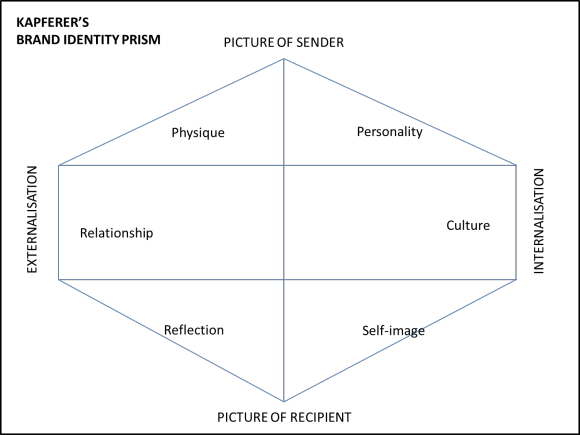
To help illustrate brand identity with a more holistic view of a brand, an internationally recognized corporate branding specialist named Jean-Noel Kapferer created a model he called the "Brand Identity Prism." The Brand Identity Prism illustrates six aspects of brand identity: physique, personality, culture, relationship, reflection, and self-image.
Image Credit: Salman Abedin
According to the model, the synthesis of each of these elements is what drives a brand's success. Here's what each of them means:

1) Physique is the recognizable, physical aspect of the brand.

It includes the logo, color scheme, packaging, and the online spaces and communities. If we're talking about Coca-Cola, it's stuff like the logo, the cursive font, the shape of its flagship glass bottle, and so on.

2) Personality is the brand's character.

It's how the brand communicates with the outside world. This might be expressed in a certain writing style or voice, design style, color scheme, and even by way of celebrity endorsements. Coca-Cola's personality is happy, playful, refreshing, and all about sharing and having a good time.

3) Culture is the value system and basic principles on which a brand bases its behavior.

There is an intimate connection between a brand's culture and its organization. Coca-Cola's culture is based around socializing and sharing.

4) Relationship refers to the relationship between people that a brand might symbolize.

One example would be a relationship between a mother and child, or among friends. Coca-Cola symbolizes an equal and friendly relationship among people in a community.

5) Reflection refers to the reflection of the consumer; in other words, the brand's most stereotypical buyer.

While a company might have multiple buyer personas, this is the "top" type of buyer. For Coca-Cola, this might be 15-18-year-olds who value fun, friendships, and sports, although Coca-Cola's target audience is much broader.

6) Self image is the consumer's ideal self.

It's kind of like a mirror the target persona holds up to him or herself. Marketers and advertisers can draw on their target audience's self image to direct their strategy and approach. A Coca-Cola drinker, for example, might see him or herself as social, communicative, and the type of person who seeks adventure and pushes boundaries.

Maggie's amazing crisis plan

I took a class in crisis management in school and as part of the class and based off of what I learned in it, I created a plan as to what I'd do in a crisis. Since a blizzard is headed my way this weekend I thought I'd post it in the hope that  it helps give some people ideas as to what to do to prepare for all hell to break loose!  The list read as follows:

What Maggie Will Do if she's in a crisis
1-I'll pack a bag with basic necessities: warm clothes to last 3-5 days, granola bars, flashlight, blanket, trail mix (essential), tooth brush, toothpaste, and other vital necessities to be decided later . (If I manage to plan ahead before the crisis hits) I'll get a gallon of water and take enough money out of my bank account to last a few days in case I have to walk somewhere far and need supplies (in case credit card/ATM machines aren't working.)

2- Since I don't have any relatives living near me to go to, and most of my friends live in the same city with me (thus meaning they'd probably be evacuated too) I'd find a shelter (which will hopefully be set up close by her apartment. If it's not close by then I'll try and take public transport to it. If public transport isn't working then I'd try and take a taxi, if that fails then I'll walk-I can be tough!)

3. If I couldn't get to a shelter for some reason, I'd batten down the hatches in my apartment (e.g. try and tape down the windows, unplug all appliances except maybe the fridge as I'd hold out hope that the power might miraculously stay on so my food doesn't get soggy. I'd then proceed to camp out in my bathroom, with my flashlight and a big container of trail mix for comfort and pray to God and all that's holy to deliver me out of the storm in one piece!

4. Modes of communication: If cell phone service and internet go out I do have a battery powered radio that I might be able to use to send a message (I have to read up on this as I'm not sure if that's possible.) Another slightly problematic factor with the radio is that I managed to break it recently and now also have to figure out how to fix it. Come to think of it, if a crisis strikes tomorrow things aren't looking so good for me in terms of my ability to communicate with the outside world. It would be at that point that I'd wish I had an owl like Harry Potter's owl or some similar bird. I think they would be very handy in a time of natural disaster to send messages if the postal services, internet and all that were out of commission. (Then again I'd have to train the owl and although they're pretty cool from a distance, owls do tend to intimidate me. Plus, the poor thing might die/get blown off course in a strong wind. Also where can one get a nice owl for keeps these days?). I thought about trying to get a passenger pigeon/homing pigeon but I think they might be sadly extinct-not much hope for me on that front then. 

Anyway, as you can see, I think I have a halfway decent plan worked out-hope it serves as inspiration as to what you all could do. Stay safe, and if all else fails, get some trail mix and camp out in the bathroom!

Brand Audit


The health of a brand needs to be critically maintained and managed if it’s to contribute sustained value to customers and brand owners over the long term. Of the many tools available for brand owners and managers to assess the well being of their brands, the brand audit is the most widely used and misunderstood.
When brands reach the inflection point where revenues begin to slide because customers no longer resonate with the brand’s value proposition, it’s time to put your finger on the pulse of your brand and determine the long-term outlook for brand health.
Conducting a comprehensive brand audit is how brand owners determine the health of their brand. Yet for some brand owners and managers, the insights gathered from brand audits can be much like reading tea leaves or making faces out of cloud formations. The results of such an effort are extremely insightful, often surprising, and even difficult to accept.
The value of a brand audit is not in the data collected, but in the action taken as a result of the insight gained. Like any navigational device, to have a sense of where the brand fits into what’s happening around it, brand audits require a triangulation of the brand’s original purpose, relevance, and resonance. A brand audit is a diagnostic process that informs a current location rather than a particular direction for brand strategy and marketing tactics. To get real value from the process, it must be a rigorous, objective and engaging process involving every discipline within the business organisation.
That’s why it’s a good idea to conduct a brand audit in collaboration with an experienced brand consultant. This will bring a lot more objectivity to the process, and the most effective method for communicating and integrating the insights into the various disciplines within the brand owner organisation.

Monday, 16 January 2017

New Product Design Process: 6 Major Steps Involved

1. Idea Generation:

The design process begins with understanding the customers and their needs. Ideas for new products can come from a variety of sources both within and outside the firm. Internal sources include employees, research and development, market research sales force and reverse engineering.
The external sources include customers, legislation, environment, technology and strategic position of the organisation. Competitors are also the source of ideas for new products or services. Perceptual maps, bench marking and reverse engineering can help companies learn from their competitors.
Perceptual maps helps to compare customer perceptions of a company’s products with competitor’s products. It is a visual method of comparing customer perceptions of different product or services:
1. Bench marking refers to finding the best in class product or process, measuring the performance of your product or process against it and making recommendations for improvement based on the results.
2. Reverse engineering refers to carefully dismantling and inspecting competitors products to look for design features that can be incorporated to improve one’s own products.
Each of these sources gives a different emphasis on the requirements and importance of idea generation.
2. Screening Ideas:
The purpose of screening ideas is to eliminate those ideas that do not appear to have high potential and so avoid the costs incurred at subsequent stages. Using group of people, proposals would be supported by graphics, models and an outline specification and judged against a set of criteria such as necessity to the firms survival, role in filling out an existing product/service, degree of overlap with existing products and services, utilizing existing processes and capabilities, impact on overall sales and profits of the company.
To have a better evaluation of ideas, each of the dimensions of the ideas is scored on a 0-10 scale and each dimension is attached weights as per these dimensions. The resulting aggregate score helps in deciding which idea to progress and which idea should be dropped.

3. Feasibility Study:

Initial screening of the ideas is designed to stop the ideas, which are unsuitable for further considerations. Feasibility study consists of a market analysis, an economic analysis, and technical and strategic analysis.

Marketing takes the ideas that are generated and the customer needs that are identified from the first stage of the design process and develops alternative product concepts. The market analysis through customer analysis and market survey assesses whether there is an enough demand for the proposed product to invest in developing further.
If the sufficient demand exists, then there is an economic analysis that aims at establishing the production and development costs and compares them with estimated sales volume. The profit potential of the product can be studied using quantitative techniques such as cost benefit analysis, decision theory, net present value (NPV) or internal rate of return (IRR).
The risk analysis is also carried out. Finally, technical and strategic analysis is concerned with technical viability of the product with respect to technology, process of manufacture, availability of materials etc. Performance specifications are written for product concepts that pass the feasibility study and are approved for development. The details of feasibility are given in fig. 2.6.
4. Preliminary Design:
Design engineers take general performance specifications and translate them in to technical specifications. The process of preliminary design involves building a prototype, testing the prototype, revising the design, retesting and so on until a viable design is determined. Design incorporates both form and function.
Form design refers to the physical appearance of a product, its shape, size, color, styling etc. Aesthetics aspects such as image, market appeal, special identification, finish etc. will also form a part of the form design.
Production design is concerned with how the product will be made. Design, which are difficult to make result in poor quality products. During the design stage itself the manufacturing aspects should be considered. The production design or design for production include simplification, standardization and modularity.
Design simplification attempts to reduce the number of parts, subassemblies and options into a product. Standardization refers to use of commonly available and interchangeable parts and subassemblies. Modular design consist of combining standardized building blocks or modules in a variety of ways to create a unique finished product. Modular design is common in electronics and automobile industry.

5. Pilot Runs and Testing:

In the preliminary design stage, prototypes are built and tested after several iterations, pilot run of the manufacturing process is conducted. Adjustments are made as needed before finalizing the design. Apart from continuously testing the product for performance, market testing is also carried out to check the acceptability of the product in the defined market and customer group. This helps to know in advance, whether customer will accept and buy this product on launching in the market. Thus, test marketing is a powerful tool.
Final Design and Process Plans:
The final design consists of detailed drawings and specifications for the new product. The accompanying process plans are workable instructions for manufacture including necessary equipment’s and tooling, component sources job descriptions, work instructions and Programmes for computer-assisted machines.

6. New Product Launch:

Launching a new product or service involves ramp up production. The process has been refined and debugged, but it has yet to operate at a sustained level of production. In ramp up, production starts at a relatively low level of volume as the organization develops confidence in its abilities to execute production consistently and marketing’s abilities to sell the product, the volume increases. Launching the new product or service involves co-coordinating the supply chain and rolling out marketing plans. Marketing and production will work in a co-coordinated way during this phase.

Rebranding Strategies: A Step-By-Step       Approach for Professional Service


There are many reasons why a professional services firm might consider rebranding. Most of them are firmly rooted in a need to reposition the firm in the marketplace. 
It could be as simple as the merger of two firms or as complex as a major shift in target clients or business strategy. But whatever the reason, a firm eventually faces the question of how to rebrand in a way that yields the desired business result.
That is what we are going to cover. What is the right strategy to rebrand your professional services firm? (Our Rebranding Kit explores these issues in-depth.)

1. Start With the Business Reason

Any rebranding strategy should start with a thorough understanding of the business reason behind the rebranding. Is it driven by a need to accelerate growth? Does your firm need to compete with larger, more established competitors?
Some of these business cases are very easy to make, such as a merger of two firms. Others are more subtle, such as outgrowing your image. If you are not clear about the business reason driving the effort, you run the risk of wasting a tremendous amount of resources. Some of the other top reasons to rebrand your professional services firm includes:
  • You need to compete at a higher level or in a new market.
  • Your brand no longer reflects who you are.
  • Your firm is spun off from an existing brand.
  • You have a legal reason compelling you to change.
  • You need to simplify and focus your message.
  • You have a new marketing team.
  • You are launching a new service line.

2. Research Your Firm and Your Target Clients

When you are clear on the business case for a rebranding, the next step is to conduct independent research on your firm and your clients. If you are attempting to move into a new market, that research should include your new target clients as well. The goal is to have an objective understanding of your current brand perception and competencies.
Without this research, you will be operating from an internal perspective only. Our own research on professional services buyers and sellers shows that virtually all firms have blind spots and distort how the marketplace sees them. After all, we are all human. Without objective research, you will build a brand on false assumptions.

3. Use Positioning and Messaging to Capture Your Brand Strategy

As you develop your firm’s market positioning and messaging architecture, you will uncover the essence of your brand strategy. Your market positioning is a brief description of where you fit into the market space. Are you an innovative leader or a low cost provider?
This positioning will drive many of your subsequent decisions. But you can’t just make something up. It needs to balance who you are as a firm and who you want to become. You must be able to support your positioning or your brand will be hollow.
Your messaging architecture articulates your messages to each of your main audiences. These messages must be consistent with your overall brand and supportable. This is not marketing copy. It is the skeleton upon which marketing copy is built.

4. Build Your Brand Identity

This is the part of the rebranding strategy where you develop the visual elements that will communicate your brand. Think firm name, logo, tagline, colors, business card design, stationary, and the like. These elements are often described in a brand style guidelines document, which provides a set of parameters to ensure your brand is implemented consistently across all of your marketing materials.
Many folks confuse these elements with your brand. Your brand is your reputation and your visibility, not your firm’s name or its logo. Your brand identity is a sort of visual shorthand for your brand.

5. Build Your Website and Online Presence

Your website is your single most important communication and business development tool. It is the place where you can tell a compelling story to each of your audiences. It is the first place a prospective client or employee will turn to learn more about your firm.
It is no exaggeration to say that a website and your online presence are the heart of a modern professional services firm. All rebranding strategies eventually involve your website. In a very real way, a website is built on the framework of your messaging architecture. Together with your remaining online presence (think social media, for example), it is the full expression of your positioning.
6. Marketing Collateral
At this point in your rebranding strategy, you will develop all of the marketing materials that you need to communicate your brand and services messages. Think pitch decks, proposal templates, brochures, one-sheet fliers and trade show booths.
These are the tools that you will use to communicate your message. They should be firmly anchored in your brand strategy.

7. Brand Building Plan

The final element of your rebranding strategy is to develop a plan to promote and strengthen your new brand. How will you launch it internally? In professional services, it is essential that your employees embrace the new brand. After all, they are your product.
It’s also important that you build the brand in a way that communicates your firm’s reputation and expertise, as well as its name. It must communicate your market positioning. Brand building is different for professional services.

Stages in the Product Lifecycle

There are four stages in the product life cycle: introduction, growth, maturity, and decline .
                            

        Firm Life Cycle

           Firms progress through stages of development, indicated by their changing profits over time.

Introduction

After all research and development has be done it is time to launch the product and begin its lifecycle. The introduction stage of the product life cycle is when the marketing team emphasizes promotion and the product's initial distribution. Often the product will have little or no competitors at this point. Nonetheless, sales may remain low because it takes time for the market to accept the new product. At this stage of the life cycle, the company usually loses money on the product.

Growth

In the growth stage of the product life cycle, the market has accepted the product and sales begin to increase. The company may want to make improvements to the product to stay competitive. At this point, there are still relatively few competitors.

Maturity

In the maturity stage of the product life cycle, sales will reach their peak. Other competitors enter the market with alternative solutions, making competition in the market fierce. The company that introduced the new product may begin to find it difficult to compete in the market.

Decline

In the decline stage of the product life cycle, sales will begin to decline as the product reaches its saturation point. Most products are phased out of the market at this point due to the decrease in sales and because of competitive pressure. The market will see the product as old and no longer in demand.
There is no set schedule for the stages of a product life cycle. Differences will occur depending on the type of product, how well it is received by the market, the promotional mix of the company, and the aggressiveness of the competition.