Wednesday, 15 February 2017

8 Step Process Perfects New Product Development


Every entrepreneur knows that productivity is one of the key ingredients for successful product development. One of the two key processes in Robert’s Rules of Innovation is the NEW PRODUCT DEVELOPMENT PROCESS. A formalised, NPD process – also referred to and best practice: the Stage Gate® Process – is a must, from simple to sophisticated.
The New Product Development process is often referred to as The Stage-Gate innovation process, developed by Dr. Robert G. Cooper as a result of comprehensive research on reasons why products succeed and why they fail.
When teams collaborate in developing new innovations, having the following eight ingredients mixed into your team’s new product developmental repertoire will ensure that it’s overall marketability will happen relatively quick, and accurately – making everyone productive across the board.

Step 1: Generating

Utilizing basic internal and external SWOT analyses, as well as current marketing trends, one can distance themselves from the competition by generating ideologies which take affordability, ROI, and widespread distribution costs into account.
Lean, mean and scalable are the key points to keep in mind. During the NPD process, keep the system nimble and use flexible discretion over which activities are executed. You may want to develop multiple versions of your road map scaled to suit different types and risk levels of projects.

Step 2: Screening The Idea

Wichita, possessing more aviation industry than most other states, is seeing many new innovations stop with Step 2 – screening.  Do you go/no go? Set specific criteria for ideas that should be continued or dropped. Stick to the agreed upon criteria so poor projects can be sent back to the idea-hopper early on.
Because product development costs are being cut in areas like Wichita, “prescreening product ideas,” means taking your Top 3 competitors’ new innovations into account, how much market share they’re chomping up, what benefits end consumers could expect etc.  An interesting industry fact: Aviation industrialists will often compare growth with metals markets; therefore, when Boeing is idle, never assume that all airplanes are grounded, per se.

Step 3: Testing The Concept

As Gaurav Akrani has said, “Concept testing is done after idea screening.” And it is important to note, it is different from test marketing.
Aside from patent research, design due diligence, and other legalities involved with new product development; knowing where the marketing messages will work best is often the biggest part of testing the concept.  Does the consumer understand, need, or want the product or service?

Step 4: Business Analytics

During the New Product Development process, build a system of metrics to monitor progress. Include input metrics, such as average time in each stage, as well as output metrics that measure the value of launched products, percentage of new product sales and other figures that provide valuable feedback. It is important for an organization to be in agreement for these criteria and metrics.
Even if an idea doesn’t turn into product, keep it in the hopper because it can prove to be a valuable asset for future products and a basis for learning and growth.

Step 5: Beta / Marketability Tests

Arranging private tests groups, launching beta versions, and then forming test panels after the product or products have been tested will provide you with valuable information allowing last minute improvements and tweaks. Not to mention helping to generate a small amount of buzz. WordPress is becoming synonymous with beta testing, and it’s effective; Thousands of programmers contribute code, millions test it, and finally even more download the completed end-product.

Step 6: Technicalities + Product Development

Provided the technical aspects can be perfected without alterations to post-beta products, heading towards a smooth step 7 is imminent. According to Akrani, in this step, “The production department will make plans to produce the product. The marketing department will make plans to distribute the product. The finance department will provide the finance for introducing the new product”.
As an example; In manufacturing, the process before sending technical specs to machinery involves printing MSDS sheets, a requirement for retaining an ISO 9001 certification (the organizational structure, procedures, processes and resources needed to implement quality management.)
In internet jargon, honing the technicalities after beta testing involves final database preparations, estimation of server resources, and planning automated logistics. Be sure to have your technicalities in line when moving forward.

Step 7: Commercialize

At this stage, your new product developments have gone mainstream, consumers are purchasing your good or service, and technical support is consistently monitoring progress.  Keeping your distribution pipelines loaded with products is an integral part of this process too, as one prefers not to give physical (or perpetual) shelf space to competition. Refreshing advertisements during this stage will keep your product’s name firmly supplanted into the minds of those in the contemplation stages of purchase.

Step 8: Post Launch Review and Perfect Pricing

Review the NPD process efficiency and look for continues improvements. Most new products are introduced with introductory pricing, in which final prices are nailed down after consumers have ‘gotten in’.  In this final stage, you’ll gauge overall value relevant to COGS (cost of goods sold), making sure internal costs aren’t overshadowing new product profits. You continuously differentiate consumer needs as your products age, forecast profits and improve delivery process whether physical, or digital, products are being perpetuated.

Remember: The Process Is Loose

The entire new product development process is an ever evolving testing platform where errors will be made, designs will get trashed, and loss could be recorded. Having your entire team working in tight synchronicity will ensure the successful launch of goods or services, even if reinventing your own wheel. Productivity during product development can be achieved if, and only if, goals are clearly defined along the way and each process has contingencies clearly outlined on paper.

Factors Affecting the Selection of the Channel of Distribution


Every producer, in order to pass on the product to the consumer, is required to select a channel for distribution. The selection of the suitable channel of distribution is one of the important factors of the distribution decisions. The following factors affect the selection of the channel of distribution:
       I.            Factors Pertaining to the Product

Keeping in view the nature, qualities and peculiarities of the product, could only the channel for distribution be properly made. The following factors concerning the product, affect the selection of the channel of distribution:
(1)   Price of the Product. The products of a lower price have a long chain of distributors. As against it, the products having higher price have a smaller chain. Very often, the producer himself has to sell the products to the consumers directly.
(2)   Perishability. The products which are of a perishable nature need lesser number of the intermediaries or agents for their sale. Under this very rule, most of the eatables (food items), and the bakery items are distributed only by the retail sellers.
(3)   Size and Weight. The size and weight of the products too affect the selection of the middlemen. Generally, heavy industrial goods are distributed by the producers themselves to the industrial consumers.
(4)   Technical Nature. Some products are of the nature that prior to their selling, the consumer is required to be given proper instructions with regard to its consumption. In such a case less of the middlemen arc) required to be used.
(5)   Goods Made to Order. The products that are manufactured as per the orders of the customers could be sold directly and the standardized items could be sold off only by the middlemen.
(6)   After-Sales Service. The products regarding which the after-sales service is to be provided could be sold off either personally or through the authorized agents.
    II.            Factors Pertaining to the Consumer or Market

The following are the main elements concerned with the consumer or the market:
(1)   Number of Customers. If the number of customers is large, definitely the services of the middlemen will have to be sought for. As against it, the products whose customers are less in number are distributed by the manufacturer himself.
(2)   Expansion of the Consumers. The span over which are the customers of any commodity spread over, also affects the selection of the channel of distribution. When the consumers are spread through a small or limited sphere, the product is distributed by the producer himself or his agent. As against it, the goods whose distributors are spread throughout the whole country, for such distributors, services of wholeseller and the retailer are sought.
(3)   Size of the Order. When bulk supply orders are received from the consumers, the producer himself takes up the responsibility for the supply of these goods. If the orders are received piece-meal or in smaller quantities, for it the services of the wholeseller could be sought. In this way, the size of the order also influences the selection of the channel of the distribution.
(4)   Objective of Purchase. If the product is being purchased for the industrial use; its direct sale is proper or justified. As against it, if the products are being purchased for the general consumption, the products reach the consumers after passing innumerable hands.
(5)   Need of the Credit Facilities. If, for the sale of any product, it becomes necessary to grant credit to any customer, it shall he helpful for the producer that for its distribution, the services of the wholeseller and retailer businessmen be sought. In this way, the need of the credit facilities too influences the selection of the channel of distribution.

 III.            Factors Pertaining to the Middlemen
The following are the main factors concerned with the middlemen:
(1)   Services Provided by Middlemen. The selection of the middlemen be made keeping in view their services. If some product is quite new and there is the need of its publicity and promotion of sales, then instead of adopting the agency system, the work must be entrusted to the representatives.
(2)   Scope or Possibilities of Quantity of Sales. The same channel should be selected by means of which there is the possibility of more sales.
(3)   Attitude of Agents towards the Producers' Policies. The producers generally prefer to select such middlemen who go by their policies. Very often when the distribution and supply policies of the producers being disliked by the middlemen, the selection of middlemen becomes quite limited.
(4)   Cost of Channel of Distribution. While selecting the channel of distribution, the cost of distribution and the services provided by the middlemen or agents too must be kept into consideration. The producers generally select the most economical channel.
  IV.            Factors Pertaining to the Producer or Company
The following factors, concerning the producer, affect the selection of the channel of distribution:
(1)   Level of Production. The manufacturers who are financially sound and are of a larger category, are able to appoint the sales representatives in a larger number and thug could distribute the commodities (products) in larger quantities. As against it, for the smaller manufacturers, it becomes necessary to procure the services of the wholesellers and the retail traders.
(2)   Financial Resources of the Company. From the financial point of view, the stronger company needs less middlemen.
(3)   Managerial Competence and Experience. If some producer lacks in the necessary managerial experience or proficiency, he will depend more upon the middlemen. The new manufacturers in the beginning remain more dependent upon the middlemen.
     V.            Other Factors
(1)   Distribution Channel of Competitors. While determining the channel of distribution, the channels of distribution of the competitors too must be borne in mind.
(2)   Social Viewpoint. What is the attitude of society towards the distribution, this fact too must be kept into consideration while selecting the middlemen. 
(3) Freedom of Altering. While selecting the agents, this fact too must be kept into mind that in case of need, there must be the liberty of changing or replacing the agents (middlemen).

Marketing Communication Channel

There is so much happening on the Social Network Marketing scene that Companies now have no option or choice but to be present in these channels. If you are planning to introduce a new product in the market or to build your brand image or reputation, the most preferred option available today happens to be the Social Media Channels.
It is true that you do not have an option but to take part and interact with your customers through those Social Media Channels where they are present. However the medium consists of a whole lot of platforms and channels that can be classified under Social Networks, Social Content and Social Interaction channels. To build an effective marketing communication strategy you would need to be present not in any one but in multiple channels depending upon the presence of your customers.
Blogging happens to be one of the easiest and simplest methods of establishing rapport with your prospective and existing customer base. Blogging includes several categories including personal blogs, Company Blogs, Micro blogging, Photo/Video Sharing and Podcasts.

Blogging - Two Way Communication

Blogging provides one of the easiest, fastest and direct ways of interacting with your audience. By creating and writing your blog, you are able to tell your customers and audience the things that you wish to tell about yourself, your product or service and your company and invite them to share their opinions and feedback etc. Blogging is an initiative from your end and you can choose the amount of time and attention you wish to pay to your blog and build social interactions. Blogging gives you a chance to elicit fair and frank discussion and opinions from the audience and community that is definitely interested in you and your product.
Blogging is not only about you talking about yourself and your product. You will get to listen and understand all about your customers too. Blogging also provides you with the opportunity to listen to your customers, to understand their expectations, their experiences as well as their feelings etc which can give you substantial insight into your own business or product and the way forward in your business. You can manage to cultivate a very close relationship with those who are able to provide you with honest feedback and build a loyal base too.

Blogging is not Advertising

The concept of blogging works different when compared to the other mediums that you use for advertising. In blogging, you are marketing to the customers but not through direct advertisements and one sided messages, but more importantly by listening to your audience, building a relationship with them, taking their feedback and trying to improve your product offering and services. You can use this medium to enhance the value that you provide to your customers. Using this medium involves listening and engaging customers in conversation as against direct advertising. Needless to say that you would need to match up with product performance and service delivery to match with the customer expectation and keep up your promised delivery too.


One of the rules that you have got to remember and follow at all times while blogging is to be transparent and open with information. If you are seriously interested in building a long term profile and reputation, it is best to avoid ‘paid blogging’ as many of the Companies do. It is better to remember that the blogger community is smart enough to be able to distinguish actual blogging from paid blogging. Any such issue can result in negative publicity which is to be avoided at any cost. Remember at all times that it is best to be open and transparent about facts regarding yourself and your business at all times. It helps to give your profile details and get your audience to know you as a person. Such transparency helps build your image and reputation online.

Tuesday, 14 February 2017

How professionals approach the logo design process

Apple. McDonalds. Twitter. Coca Cola. Nike.
What makes those symbols so special and iconic?
Is it their beauty or the colors? Maybe it’s because they explain what the company does…or maybe not?
While these things are considered during a logo design project, none of them are particularly important. Some great logos are beautiful and some (according to many) are downright ugly. Few of them suggest what the company does but others don’t really bother. If you look at the colors, there really are no rules.
So, if none of these things are responsible for making a logo great, what is?
It’s distinctiveness.
That is the single, most important trait of any professional logo. If it truly stands out from the rest and makes the brand unique and memorable, while respecting some basic design principles, it qualifies as great.
Clients all over the world look for and pay for that kind of work, and logo design professionals know how to do exactly that.
How do they do it, you wonder?

1. Client discovery

A great logo is an expression of the company values, culture and people. Think of it as an employee whose main job is to be distinctive and represent the company in the best possible way. What would he look like? How would he feel like? Is he a boss or the guy next door? Is he loud and cheerful or wise and calm?
You cannot answer questions like these without making wrong assumptions.
That’s why professionals kick-off logo design projects with some good, quality conversations with the client. They aim to learn as much as possible about the company culture, values and the way they do business, and then inject that message when they design a logo.
Landor designed the new British Petroleum logo based on in-depth understanding if their values and culture, as well as what they wanted to communicate.
By completing this step, you’re not creating a logo that looks like a total stranger to your client and other stakeholders in the company.
So don’t stop at reading the brief – kick-off your logo design projects by asking a client some specific questions you want to know about his business. Ask about their values, their personality and their customers.
Get to know how they think, so you know what is appropriate for them.

2. Industry discovery

Once you get to know the client, you’ll need to find out more about:
  • who is the logo for (the audience)
  • who you’re up against (the competition)
Knowing the audience will give you some clues as to where you need to take the logo, style wise. For example, if you’re working for a teenage market, you’ll probably need something mainstream, loud and catchy. But if your teenagers are wunderkinds who dig computer programming, you may need to think harder.
Grooveshark came shortly after Spotify, with a completely different and distinctive look which works well with younger audience and gives them a unique spin.
That’s why you need to ask the client to tell you as much as possible about the customers they are catering to — who are they, where they live, what they buy, how they dress. The more you know about these target audience, the easier it will be for you to create a logo they can fall in love with.
The second, and perhaps more important part of this process is researching your client’s competition. You need to see who else is out there and how their logos look, so you avoid doing something similar, or worse — doing something identical. Remember, your work has to set the client apart from everybody else, so ask the client to give you a list of key competitors you need to consider.

3. Application discovery

This phase is about answering one simple question: how and where will the logo be used most of the time? Different usage of the logo is typically referred to as “logo application.”
This is really essential for the logo design process because it tells the designer what can and cannot be done from a design point of view.
Airline companies need their logos visible on tail fins – an important thing to consider before jumping to the design stage.
For example, airline companies demand a very specific type of logo application, where a logo has to be placed on the tail fin of the airplane. That is a very tall and narrow space to work with, so designers will have to avoid ideas that do not fit there, or develop separate graphics that will be used for that purpose.
Another example are web-based companies, who do most of their business online. In this case, designers might decide to use full RGB spectrum for the logo, because digital devices have no problems with that and it might help the logo stand out. On the other hand, this would be a very bad choice for a company who does business offline and has to print a lot of stuff.
For this reason, always think carefully about where their logo will be used most of the time, so you don’t waste time on ideas that cannot be executed in practice.

4. Sketching (a lot)

Did you know that some design schools ask the students to come up with exactly 100 ideas before they decide on the right one? The reason is simple — the only way to separate the good from the bad is to have a lot of things to pick from.
Because of this simple truth, professional identity designers usually sketch dozens of logo ideas during the brainstorming phase, then pick only a handful to present to the client.
Designer David Airey shows his sketches behind the memorable Henri Ehrhart logo.
As hard as it may sound, this really isn’t that lengthy of a process. Sketching a logo with a pen and paper takes less than a minute; with all the thinking in between, you can easily sketch 10 in under an hour.
Never get fooled by thinking your first ideas are your best.
Sketch, then sketch some more, so you can really separate the wheat from the chaff.
That’s how professionals do it.

5. Draft designs

After you’re done with the sketching process, pick 5-7 of your best ideas and create some initial designs in Illustrator or other vector based apps. As a reminder, the best ideas are not the nicest looking ones or the safe ones which look like everything else out there — they are ideas which have the chance to make your client truly stand out in the market.
Jacob Cass shows his drafts for a UKE logo.
Create some quick designs in black and white, then present them to the client for initial review. Don’t bother with adding color and detail — keeping things simple will put the focus on the ideas themselves instead of tiny details, which is much more desirable at this stage.
Your main objective is to get client feedback on your rough ideas and identify the ones they’d like to refine.

6. Refinement

The refinement stage is the longest one because it involves a lot of back and forth regarding the improvements and changes for the presented logo drafts.
Sometimes the client will pick just one idea for refinement — sometimes he’ll run two or three in parallel just to see where they go.
But here’s where the fun happens.
Helvetic Brands shows their logo development & refinement processfor CAPRA.
Colors, details and various bells and whistles are added, changed and thrown away during logo refinement stage. Various application mockups are developed to see how the logo will perform in different situations — sometimes a logo detail on paper doesn’t really work well on a building.
Ultimately, the final logo is chosen, approved and prepared for identity development.

7. Identity development

As you can imagine, a great logo is not the end but the beginning of a great brand identity.
Business stationery, signage, vehicle branding and many other communication tools have to be designed so they all send a unified brand message. Identity development makes that happen.
During this stage, all important logo applications are designed and standardized in a brand guidelines book, known simply as “brand book.”
Identity devlopment takes the logo further and defines visual standards for all commonly used marketing and promotional tools.
This book shows how to work with the logo and prescribes standard layout, color, imagery and typography guidelines for common marketing materials. This way companies make sure their identity is protected and guided by the same principles even when they switch designers or agencies.
Note while the identity development stage is optional, it is usually offered as a part of the total identity design package — most clients want to standardize at least business stationery and signage.

How you can benefit from this process?

As you can see, the professional logo design process is a rather serious business involving seven distinct stages, all with an aim to create a unique, memorable symbol that adds value to the company and makes it stand out in the market.
However, it’s important to understand that this isn’t something reserved for the big agencies or designers — everybody can benefit from following these steps, and clients will appreciate you more because of it.
So for your next logo design contest, start by taking things seriously. Don’t stop at the brief — ask the client as much as you can about his business, his audience, competitors and logo application needs. Do some sketching and share your early designs with the client. Refine based on what you hear. Offer to design a brand book once you win a competition, and make use of 1-to-1 invoicing.

Brand Identity

Chances are, if someone mentions GoPro, you think of a super-sturdy camera for the adventurous.
Why's that? Because GoPro has done a good job defining its brand. Great brands like GoPro are easy to recognize. Their missions are clear, and they foster that customer loyalty all businesses crave.
A brand is one of the most valuable assets of a business, and it needs to be carefully crafted to ensure it properly and authentically represents the business.
Crafting a brand is a shared endeavor, though. Customers, employees, blog readers (sound familiar?), and anyone who interacts with a business has a role in shaping the brand, which is why we've created a very short survey to see what HubSpot means to you. Because what it means to you will help us deliver on your expectations. (We'll get to that a little later in the post.)
Do you know how your brand is doing? Does your business have a brand identity?
If it doesn't, or your brand isn't as strong as it could be, follow along with this post. Branding may seem like a fluffy concept, but we're going to try to put some structure around it so any marketing team can get started defining their brand strategy.

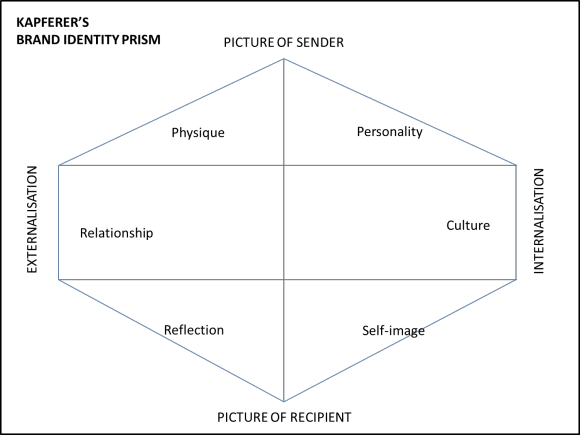
The Brand Identity Prism

To help illustrate brand identity with a more holistic view of a brand, an internationally recognized corporate branding specialist named Jean-Noel Kapferer created a model he called the "Brand Identity Prism." The Brand Identity Prism illustrates six aspects of brand identity: physique, personality, culture, relationship, reflection, and self-image.
Image Credit: Salman Abedin
According to the model, the synthesis of each of these elements is what drives a brand's success. Here's what each of them means:

1) Physique is the recognizable, physical aspect of the brand.

It includes the logo, color scheme, packaging, and the online spaces and communities. If we're talking about Coca-Cola, it's stuff like the logo, the cursive font, the shape of its flagship glass bottle, and so on.

2) Personality is the brand's character.

It's how the brand communicates with the outside world. This might be expressed in a certain writing style or voice, design style, color scheme, and even by way of celebrity endorsements. Coca-Cola's personality is happy, playful, refreshing, and all about sharing and having a good time.

3) Culture is the value system and basic principles on which a brand bases its behavior.

There is an intimate connection between a brand's culture and its organization. Coca-Cola's culture is based around socializing and sharing.

4) Relationship refers to the relationship between people that a brand might symbolize.

One example would be a relationship between a mother and child, or among friends. Coca-Cola symbolizes an equal and friendly relationship among people in a community.

5) Reflection refers to the reflection of the consumer; in other words, the brand's most stereotypical buyer.

While a company might have multiple buyer personas, this is the "top" type of buyer. For Coca-Cola, this might be 15-18-year-olds who value fun, friendships, and sports, although Coca-Cola's target audience is much broader.

6) Self image is the consumer's ideal self.

It's kind of like a mirror the target persona holds up to him or herself. Marketers and advertisers can draw on their target audience's self image to direct their strategy and approach. A Coca-Cola drinker, for example, might see him or herself as social, communicative, and the type of person who seeks adventure and pushes boundaries.

Maggie's amazing crisis plan

I took a class in crisis management in school and as part of the class and based off of what I learned in it, I created a plan as to what I'd do in a crisis. Since a blizzard is headed my way this weekend I thought I'd post it in the hope that  it helps give some people ideas as to what to do to prepare for all hell to break loose!  The list read as follows:

What Maggie Will Do if she's in a crisis
1-I'll pack a bag with basic necessities: warm clothes to last 3-5 days, granola bars, flashlight, blanket, trail mix (essential), tooth brush, toothpaste, and other vital necessities to be decided later . (If I manage to plan ahead before the crisis hits) I'll get a gallon of water and take enough money out of my bank account to last a few days in case I have to walk somewhere far and need supplies (in case credit card/ATM machines aren't working.)

2- Since I don't have any relatives living near me to go to, and most of my friends live in the same city with me (thus meaning they'd probably be evacuated too) I'd find a shelter (which will hopefully be set up close by her apartment. If it's not close by then I'll try and take public transport to it. If public transport isn't working then I'd try and take a taxi, if that fails then I'll walk-I can be tough!)

3. If I couldn't get to a shelter for some reason, I'd batten down the hatches in my apartment (e.g. try and tape down the windows, unplug all appliances except maybe the fridge as I'd hold out hope that the power might miraculously stay on so my food doesn't get soggy. I'd then proceed to camp out in my bathroom, with my flashlight and a big container of trail mix for comfort and pray to God and all that's holy to deliver me out of the storm in one piece!

4. Modes of communication: If cell phone service and internet go out I do have a battery powered radio that I might be able to use to send a message (I have to read up on this as I'm not sure if that's possible.) Another slightly problematic factor with the radio is that I managed to break it recently and now also have to figure out how to fix it. Come to think of it, if a crisis strikes tomorrow things aren't looking so good for me in terms of my ability to communicate with the outside world. It would be at that point that I'd wish I had an owl like Harry Potter's owl or some similar bird. I think they would be very handy in a time of natural disaster to send messages if the postal services, internet and all that were out of commission. (Then again I'd have to train the owl and although they're pretty cool from a distance, owls do tend to intimidate me. Plus, the poor thing might die/get blown off course in a strong wind. Also where can one get a nice owl for keeps these days?). I thought about trying to get a passenger pigeon/homing pigeon but I think they might be sadly extinct-not much hope for me on that front then. 

Anyway, as you can see, I think I have a halfway decent plan worked out-hope it serves as inspiration as to what you all could do. Stay safe, and if all else fails, get some trail mix and camp out in the bathroom!

Brand Audit


The health of a brand needs to be critically maintained and managed if it’s to contribute sustained value to customers and brand owners over the long term. Of the many tools available for brand owners and managers to assess the well being of their brands, the brand audit is the most widely used and misunderstood.
When brands reach the inflection point where revenues begin to slide because customers no longer resonate with the brand’s value proposition, it’s time to put your finger on the pulse of your brand and determine the long-term outlook for brand health.
Conducting a comprehensive brand audit is how brand owners determine the health of their brand. Yet for some brand owners and managers, the insights gathered from brand audits can be much like reading tea leaves or making faces out of cloud formations. The results of such an effort are extremely insightful, often surprising, and even difficult to accept.
The value of a brand audit is not in the data collected, but in the action taken as a result of the insight gained. Like any navigational device, to have a sense of where the brand fits into what’s happening around it, brand audits require a triangulation of the brand’s original purpose, relevance, and resonance. A brand audit is a diagnostic process that informs a current location rather than a particular direction for brand strategy and marketing tactics. To get real value from the process, it must be a rigorous, objective and engaging process involving every discipline within the business organisation.
That’s why it’s a good idea to conduct a brand audit in collaboration with an experienced brand consultant. This will bring a lot more objectivity to the process, and the most effective method for communicating and integrating the insights into the various disciplines within the brand owner organisation.